

 The Home Growns
Problem #2: Overwatering and Underwatering — Finding the Perfect Balance
Can I tell you something embarrassing? I once killed a succulent by overwatering it.
A succulent. The plant that’s literally designed to survive drought. 😅
The Signs Your Plants Are Drowning (Yes, Really)
Overwatering is actually the #1 cause of houseplant and garden plant death in the U.S. — and it’s sneaky because the symptoms look almost identical to underwatering.
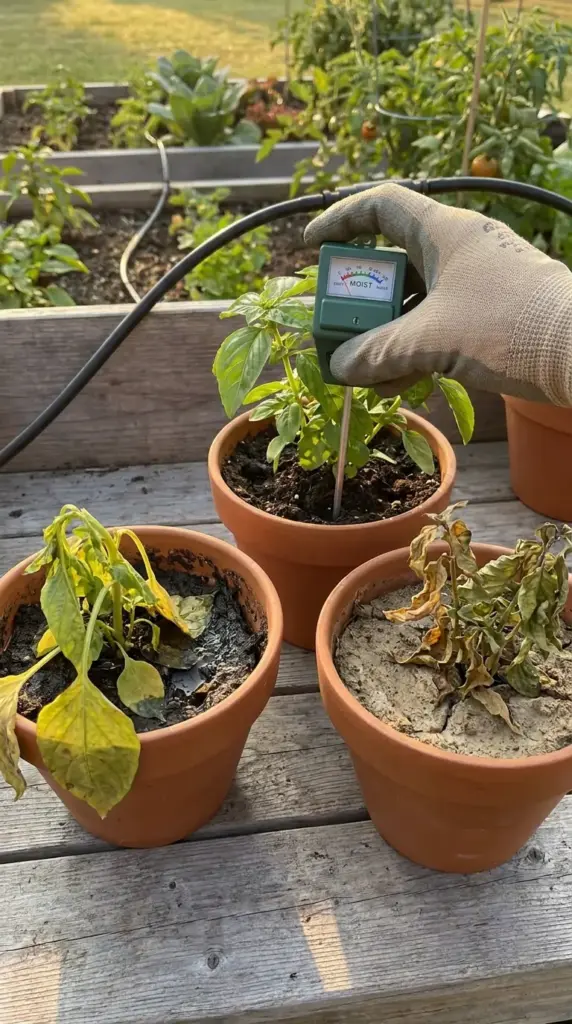
Here’s what too much water actually looks like:
- Leaves that are yellow, soft, and mushy at the base
- Soil that stays wet for more than 2-3 days after watering
- A musty smell coming from the soil — that’s root rot setting in
- Stems that feel soft or slimy near the soil line
And underwatering? That looks like this:
- Leaves that are dry, crispy, and curling inward
- Soil pulling away from the edges of the pot or bed
- Wilting that doesn’t recover even after you water
- Slow, stunted growth despite good sunlight
The key difference is texture. Overwatered leaves feel soft and limp. Underwatered leaves feel dry and brittle. Once you know that, you’ll never confuse the two again.
How to Build a Watering Schedule Based on Where You Live
This is where so many gardeners go wrong — they follow generic watering advice without accounting for their local climate.
A gardener in Seattle might only need to water once a week in spring because rainfall does most of the work. But that same schedule in Dallas or Los Angeles during July? Your plants will be crispy within days.
Here’s a simple framework that actually works:
- Hot, dry climates (Dallas, LA, Atlanta) — water deeply 3-4 times per week in summer, early morning only
- Humid, moderate climates (New York, Philadelphia, Washington DC) — water 2-3 times per week, adjusting after rainfall
- Cool, wet climates (Seattle, Minneapolis) — water 1-2 times per week in spring, more in dry summer stretches
- Cold climates in winter (Chicago, Detroit, Minneapolis) — most plants need almost no supplemental watering once dormant
The golden rule? Water deeply and less frequently rather than a little bit every day. Deep watering encourages roots to grow downward — which makes plants dramatically more drought-resistant over time.
Shallow, frequent watering does the opposite. It trains roots to stay near the surface, making your plants fragile and high-maintenance.
The Best Watering Tools for a Consistent, Efficient Garden
Look, I used to just drag a hose around and eyeball everything. It was chaotic, inconsistent, and honestly kind of exhausting.
Then I discovered drip irrigation — and it genuinely changed my gardening life.
A basic drip irrigation system delivers water slowly and directly to the root zone, which means:
- Up to 50% less water waste compared to overhead sprinklers
- No wet foliage, which dramatically reduces fungal disease risk
- Consistent moisture levels that plants love
You can get a solid starter drip system on Amazon for around $25-$40 — brands like Rain Bird and Orbit are reliable and easy to set up without any plumbing experience.
Soaker hoses are another fantastic option, especially for long garden rows or raised beds. They seep water slowly along their entire length, and a 50-foot soaker hose runs about $15-$20 at most garden supply stores.
For container gardens, a simple watering can with a long, narrow spout gives you the most control — the Haws Slimcan is my personal favorite for getting water directly to the soil without splashing leaves.
Moisture Meters: The Tool Every Gardener Needs (Seriously)
Okay, if there’s one gardening supply I recommend to every single person who asks me about plant care — it’s a moisture meter.
It’s a simple probe you stick into the soil, and it tells you on a scale of 1-10 exactly how wet or dry your soil is. No more guessing. No more “does this feel damp enough?”
The XLUX Soil Moisture Meter is around $12 on Amazon and has thousands of five-star reviews for good reason. It requires no batteries and lasts for years.
Here’s a quick guide to reading it:
- 1-3: Dry — time to water
- 4-7: Moist — perfect for most plants
- 8-10: Wet — put the watering can down
I check mine before every single watering session now. It takes 10 seconds and has saved me from making so many mistakes.
Container Gardens vs. In-Ground Beds: The Watering Difference
This is something that really trips people up — and understandably so.
Container gardens dry out 2-3 times faster than in-ground beds because pots have limited soil volume and drainage holes pulling moisture out constantly.
In the heat of a Dallas or Atlanta summer, a container plant might need watering every single day. That’s not a sign something is wrong — that’s just container gardening reality.
In-ground beds, on the other hand, benefit from the surrounding soil acting as a moisture reservoir. They’re far more forgiving if you miss a watering day.
A few key rules for container watering:
- Always water until it drains freely from the bottom — this ensures the entire root zone gets moisture
- Never let containers sit in standing water — that’s a fast track to root rot
- In summer, check container soil moisture every morning before the heat of the day sets in
- Terracotta pots dry out faster than plastic or glazed ceramic — factor that into your schedule
Up Next: The Weed War
So your soil is healthy and your watering is dialed in. But there’s another problem quietly taking over your garden beds while you sleep.
👇 Hit “Next” below — because we’re tackling the never-ending battle against weeds, and I’ve got some organic control methods that will make your life so much easier.

GIPHY App Key not set. Please check settings