
 The Home Growns
Problem #10: Invasive Plants Ruining Your Garden Design
I bought a gorgeous plant called Bishop’s Weed at a garden sale once.
The lady selling it literally said — and I quote — “it spreads a little.” 😑
Three years later it had consumed two entire garden beds, was growing through my fence, and had started appearing in my neighbor’s yard. I spent the better part of two summers trying to get rid of it.
“Spreads a little.” Sure.
What Makes a Plant “Invasive” — And Why It Matters
Here’s the distinction that actually matters for home gardeners:
Aggressive plants spread enthusiastically but can be managed with regular maintenance. Invasive plants spread so rapidly and persistently that they outcompete and displace everything around them — including native plants that local wildlife depends on for survival.
The difference isn’t just about your garden. It’s about your entire local ecosystem.
When invasive plants escape garden boundaries — through seeds carried by birds, roots spreading underground, or cuttings washing into waterways — they can devastate local habitats. The U.S. Department of Agriculture estimates that invasive species cause approximately $120 billion in environmental and economic damage annually in the United States.
That’s not a small problem.
And the frustrating part? Many of the most destructive invasive plants are still being sold at garden centers across the country because regulation varies so much by state.
The Most Common Invasive Plants in U.S. Urban and Suburban Gardens
This list might surprise you — because several of these are genuinely beautiful plants that are widely sold and planted.
English Ivy (Hedera helix)
Probably the most commonly planted invasive in American gardens. It looks lush, covers bare ground quickly, and seems like the perfect low-maintenance ground cover.
The reality: English ivy climbs trees and eventually kills them by blocking sunlight and adding weight that makes trees vulnerable to storm damage. It creates dense monocultures on the forest floor that eliminate native wildflowers and ferns. It’s invasive in most eastern U.S. states and problematic in the Pacific Northwest.
If you have it in your garden — especially in cities like Philadelphia, Washington DC, Atlanta, and Seattle — it’s worth seriously considering removal.
Japanese Honeysuckle (Lonicera japonica)
Sweetly fragrant, covered in beautiful white and yellow flowers, beloved by hummingbirds. Also one of the most aggressively invasive vines in the eastern United States.
It grows up to 30 feet in a single season, smothering shrubs and small trees under its weight. It’s particularly problematic in Mid-Atlantic and Southeastern states — Washington DC, Philadelphia, Atlanta, and Dallas gardeners should be especially cautious.
Burning Bush (Euonymus alatus)
This one genuinely breaks my heart because the fall color is spectacular — brilliant scarlet red that stops people in their tracks.
But birds eat the berries and spread seeds into natural areas, where burning bush outcompetes native shrubs. It’s invasive throughout the Northeast and Midwest — including New York, Chicago, Detroit, and Minneapolis — and is actually banned for sale in Massachusetts and New Hampshire.
Purple Loosestrife (Lythrum salicaria)
Tall, magenta-purple flower spikes that look absolutely stunning in late summer. And absolutely devastating in wetland ecosystems.
A single purple loosestrife plant can produce up to 2.7 million seeds per year. It has taken over wetlands across the northern United States, eliminating native cattails and marsh plants that waterfowl and amphibians depend on. Problematic in virtually every northern U.S. city.
Japanese Barberry (Berberis thunbergii)
A popular landscape shrub with attractive red berries and fall color. Also a documented host for black-legged ticks — the primary carrier of Lyme disease — because its dense, thorny interior creates perfect tick habitat.
Studies have found tick densities up to 12 times higher in areas with Japanese barberry than in areas without it. That alone should be enough reason to remove it. Invasive throughout the Northeast and Mid-Atlantic — New York, Philadelphia, Washington DC, and Chicago gardeners take note.
Kudzu (Pueraria montana)
If you’ve ever driven through the American South, you’ve seen kudzu — the vine that ate the South. It grows up to one foot per day in summer and can completely engulf trees, buildings, and utility poles.
Primarily a problem in Atlanta and throughout the Southeast, but it’s been spreading northward as winters warm.
Creeping Charlie (Glechoma hederacea)
This one is in virtually every lawn and garden in the Midwest and Northeast — Chicago, Minneapolis, Detroit, and New York gardeners know it well. Low-growing, with small purple flowers and scalloped leaves, it spreads by both seed and creeping stems that root at every node.
It’s almost impossible to fully eradicate once established — which is why prevention and early intervention matter so much.
Chinese Wisteria (Wisteria sinensis)
Breathtakingly beautiful. Genuinely terrifying in its invasiveness.
Chinese wisteria can grow 10 feet in a single season, with woody vines strong enough to pull down fences, crush pergolas, and girdle mature trees. It’s invasive throughout the eastern United States and particularly problematic in the Mid-Atlantic and Southeast.
The good news: American wisteria (Wisteria frutescens) is a beautiful native alternative that blooms just as prolifically without the invasive behavior.
How to Identify Invasive Plants Before You Plant Them
The best time to stop an invasive plant is before it goes in the ground.
Here are the resources I use and recommend:
The USDA PLANTS Database (plants.usda.gov) — searchable by plant name or state, with invasive status clearly listed. Free and comprehensive.
iNaturalist app — photograph any plant and the app uses AI to identify it and flag invasive status. Incredibly useful for identifying mystery plants already growing in your garden.
Your state’s invasive species council website — every state has one, and they maintain updated lists of plants that are invasive specifically in your region. What’s invasive in Atlanta may not be invasive in Seattle — regional specificity matters enormously.
Local cooperative extension office — your county extension agent can identify plants from photos or samples and tell you definitively whether they’re invasive in your specific area.
Safe Removal Methods That Won’t Damage Surrounding Plants
Removing established invasive plants is genuinely hard work. I won’t pretend otherwise.
But the approach you take matters enormously — wrong removal techniques can actually spread invasives faster than doing nothing.
For vining invasives (English ivy, Japanese honeysuckle, wisteria):
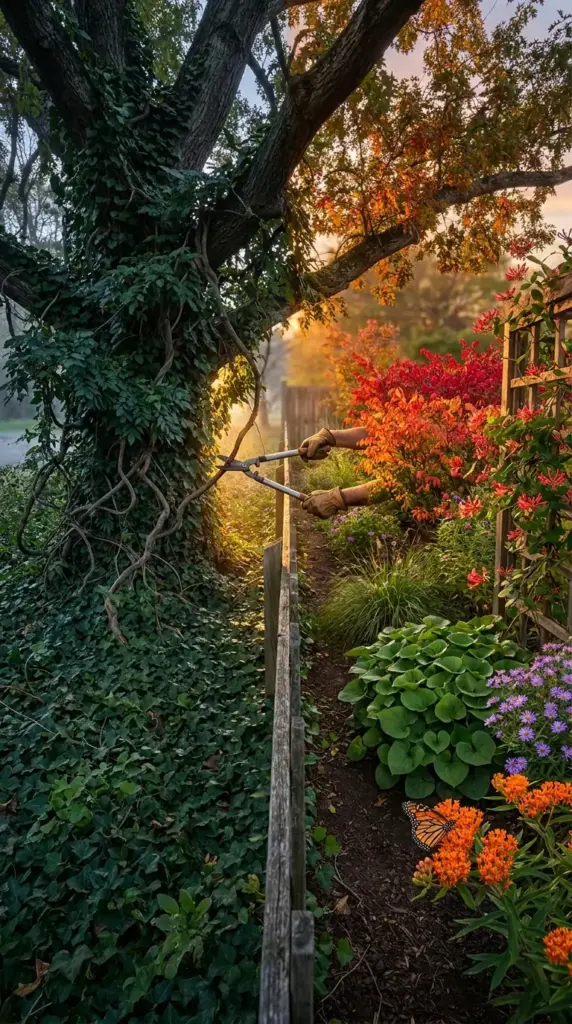
- Never pull vines down from trees by yanking — this can damage tree bark and scatter seeds. Instead, cut vines at the base and let them die in place before removing
- Use loppers or pruning shears to cut stems at ground level, then immediately treat the cut stem with a concentrated glyphosate or triclopyr solution applied with a small paintbrush — this prevents resprouting without spraying herbicide broadly
- Remove root systems as completely as possible — most vining invasives resprout vigorously from root fragments
- Repeat treatment every 4-6 weeks throughout the growing season — one removal session is never enough
For spreading ground covers (English ivy, creeping Charlie, Bishop’s Weed):
- Smother with cardboard and thick mulch — lay cardboard directly over the invasive, overlap edges by at least 6 inches, then cover with 6-8 inches of wood chip mulch. This blocks light and kills most ground-covering invasives within one season
- For persistent invasives, follow cardboard smothering with targeted herbicide treatment on any regrowth that pushes through
- Repeated hand pulling works for smaller infestations — pull after rain when soil is soft, getting as much root as possible. Bag everything immediately — don’t compost invasive plant material
For shrubby invasives (burning bush, Japanese barberry):
- Cut to the ground with loppers or a pruning saw in late summer or early fall
- Immediately treat the cut stump with concentrated triclopyr (found in products like Brush-B-Gon) to prevent resprouting
- Dig out the root ball if the shrub is small enough — this is the most reliable long-term solution
- Monitor the area for 2-3 years and treat any regrowth immediately
The golden rule of invasive removal:
Never put invasive plant material in your compost bin. Many invasives can regenerate from small stem or root fragments — even partially composted ones. Bag everything in heavy-duty garbage bags and put it in the trash.
For large-scale infestations — especially kudzu in Atlanta or English ivy in Seattle — don’t be too proud to hire a professional removal service. Some invasives are simply beyond DIY management at a certain scale.
Replacing Invasives With Beautiful Native Plants
Here’s the part I genuinely love — because native plants are so much more interesting than most people expect.
The narrative around native plants used to be that they were the “responsible but boring” choice. That narrative is completely outdated.
Today’s native plant movement has produced stunning, garden-worthy selections that rival anything you’d find at a conventional garden center — while supporting local birds, butterflies, and pollinators in ways that non-native plants simply cannot.
Replacing English Ivy:
- Wild ginger (Asarum canadense) — lush, heart-shaped leaves that form a dense, weed-suppressing carpet in shade. Spreads slowly but reliably. Native to eastern North America
- Pennsylvania sedge (Carex pensylvanica) — fine-textured, grass-like ground cover that stays green almost year-round in mild climates. Perfect for shady areas under trees where grass won’t grow
- Green-and-gold (Chrysogonum virginianum) — semi-evergreen ground cover with cheerful yellow flowers in spring and fall. Spreads at a reasonable pace without becoming invasive
Replacing Burning Bush:
- Itea virginica (Virginia sweetspire) — brilliant red fall color that rivals burning bush, with fragrant white flower spikes in summer. Native to the eastern U.S. and genuinely stunning in fall
- Fothergilla — another spectacular native shrub with honey-scented white flowers in spring and extraordinary orange-red fall color. Thrives in the same conditions as burning bush
- Aronia (Chokeberry) — white spring flowers, glossy summer foliage, brilliant fall color, and berries that birds absolutely love. One of the most underused native shrubs in American gardens
Replacing Japanese Honeysuckle:
- Coral honeysuckle (Lonicera sempervirens) — a native honeysuckle with stunning red and orange tubular flowers that hummingbirds are obsessed with. Blooms spring through fall without any invasive behavior
- Crossvine (Bignonia capreolata) — vigorous native vine with large, trumpet-shaped flowers in orange and red. Excellent for covering fences and trellises in southeastern gardens
- Virgin’s bower (Clematis virginiana) — delicate white flowers in late summer followed by feathery seed heads that look beautiful through winter
Replacing Chinese Wisteria:
- American wisteria (Wisteria frutescens) — all the beauty of Chinese wisteria with none of the invasive behavior. Varieties like ‘Amethyst Falls’ bloom repeatedly throughout summer and are perfectly behaved on a trellis or pergola
- ‘Blue Moon’ Kentucky wisteria — extremely cold-hardy (to Zone 3), blooms three times per season, and stays manageable. Perfect for Minneapolis and Chicago gardeners who want wisteria without the nightmare
How Native Planting Enhances Garden Design AND Reduces Maintenance
Here’s the argument for native plants that I find most compelling — and it has nothing to do with ecology.
Native plants are dramatically lower maintenance than non-native plants once they’re established.
They evolved in your specific climate, with your specific rainfall patterns, your specific soil conditions, and your specific pest pressures. They’re literally designed for where you live.
What that means practically:
- Less watering — established native plants typically need little to no supplemental irrigation beyond their first season
- Less fertilizing — native plants are adapted to local soil nutrient levels and rarely need amendment
- Less pest and disease management — native plants have co-evolved with local insects and pathogens, developing natural resistance that non-native plants lack
- Less replacement — native plants are perennial investments that return and spread year after year rather than needing annual replanting
A University of Delaware study found that homeowners with native plant gardens spent an average of $200-$300 less per year on garden maintenance than those with conventional non-native landscapes.
That’s real money — and real time back in your weekend.
From a design perspective, native plants offer something that conventional garden plants often don’t: a sense of place. A garden planted with natives from your specific region looks like it belongs there — it has an authenticity and coherence that’s genuinely difficult to achieve with a random collection of plants from around the world.
Resources for Finding Native Plants in Your City
Finding quality native plants has gotten dramatically easier in recent years — but you still need to know where to look.
Online resources:
- Audubon Society Native Plant Database (audubon.org/native-plants) — enter your zip code and get a customized list of native plants for your specific area, with information on which birds and pollinators each plant supports
- Lady Bird Johnson Wildflower Center Native Plant Database (wildflower.org) — the most comprehensive native plant database available, searchable by state, sun exposure, soil type, and plant characteristics
- iNaturalist — use it to identify native plants already growing in natural areas near your home. What’s thriving in your local park is almost certainly going to thrive in your garden
- Homegrown National Park (homegrownnationalpark.org) — Doug Tallamy’s initiative with a searchable map of native plant gardens and nurseries near you
Local resources by city:
- New York: Greenbelt Native Plant Center on Staten Island sells native plants to the public seasonally
- Chicago: The Chicago Botanic Garden hosts an annual native plant sale every spring — one of the best in the Midwest
- Seattle: Swansons Nursery and Sky Nursery both carry excellent native plant selections
- Philadelphia: Bowman’s Hill Wildflower Preserve is one of the premier native plant nurseries on the East Coast
- Atlanta: State Botanical Garden of Georgia plant sales and Beech Hollow Farmstead native nursery
- Washington DC: Earth Sangha Wild Plant Nursery specializes exclusively in locally native plants
- Dallas: Native American Seed company (nativeamericanseed.com) ships regionally appropriate native seeds and plants throughout Texas
- Minneapolis: Prairie Moon Nursery is one of the best native plant nurseries in the entire country — highly recommend for Midwest gardeners
- Detroit: Wildtype Native Plant Nursery in nearby Mason, Michigan is excellent for Great Lakes region natives
- Los Angeles: Theodore Payne Foundation for Wild Flowers and Native Plants is the gold standard for Southern California natives
A Simple Invasive-to-Native Swap Guide
| Remove This Invasive | Plant This Native Instead |
|---|---|
| English Ivy | Wild Ginger or Pennsylvania Sedge |
| Burning Bush | Virginia Sweetspire or Fothergilla |
| Japanese Honeysuckle | Coral Honeysuckle |
| Chinese Wisteria | American Wisteria ‘Amethyst Falls’ |
| Japanese Barberry | Native Spicebush (Lindera benzoin) |
| Purple Loosestrife | Blue Flag Iris or Swamp Milkweed |
| Creeping Charlie | Wild Ginger or Green-and-Gold |
Screenshot that table. It’ll save you a lot of time at the garden center.
Up Next: Making Your Garden Actually Beautiful
You’ve solved the problems. You’ve fixed the mistakes. Now it’s time to talk about something really fun.
👇 Click “Next” below — because we’re diving into garden design next, and I’m going to show you how to create a backyard that looks intentional, gorgeous, and completely like you — regardless of your budget or experience level.

GIPHY App Key not set. Please check settings