

 The Home Growns
6. Maximizing Light with Reflective Surfaces and Grow Lights
Honestly, this section changed my entire gardening game.
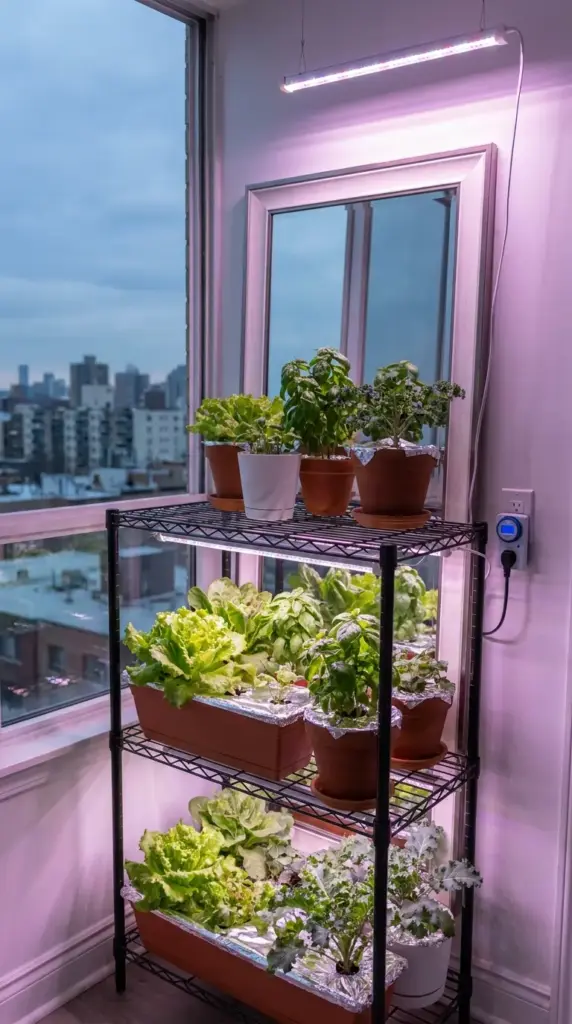
The day I propped a cheap mirror behind my balcony planters was the day everything clicked. 💡
Using Mirrors, White Walls, and Reflective Mulch
Reflective surfaces are basically free light — and most gardeners completely overlook them.
A simple white-painted wall or fence behind your containers can increase available light by up to 20%. That’s significant for shade-tolerant crops already working overtime.
Reflective mulch — silver or white-colored ground cover — bounces light upward directly onto lower leaves. It’s inexpensive, practical, and genuinely effective.
The Best Affordable Grow Lights for Small Spaces
You don’t need to spend a fortune here. Promise.
Bar-style LED grow lights are currently the gold standard for small indoor and balcony setups — they distribute light evenly and run surprisingly cool compared to older bulb styles.
Brands like Barrina and Spider Farmer offer excellent entry-level options between $30 and $80.
Full-Spectrum LED Grow Lights — What to Look For
Always look for lights labeled “full spectrum” — they mimic natural sunlight most accurately.
Check the PPFD rating (Photosynthetic Photon Flux Density) — for leafy greens and herbs, you want somewhere between 200 and 400 PPFD at canopy level.
My personal 2026 favorites? The Spider Farmer SE3000 and Barrina T5 Full Spectrum — both affordable, reliable, and highly rated.
Setting Up a Grow Light Schedule
Plants need darkness just as much as light — don’t make the mistake of running lights 24 hours.
A 16-hours-on, 8-hours-off schedule works beautifully for most leafy greens and herbs.
Use an inexpensive digital outlet timer (around $10 on Amazon) to automate everything effortlessly.
Combining Natural and Artificial Light
Think of grow lights as a supplement, not a replacement, for natural light.
Position your grow lights to cover the hours when natural light is weakest — typically early morning and late afternoon in dense urban environments.
This hybrid lighting approach produces noticeably healthier, more productive plants.
Budget-Friendly DIY Grow Light Setups
A simple wire shelving unit from IKEA paired with clip-on full-spectrum LED bars creates an incredibly effective DIY grow station for under $60.
Crafty gardeners in small apartments swear by this setup — and honestly, it looks pretty cool too. 🌿
Next, we’re talking about something equally important — watering routines and garden care that keep your shaded mini farm thriving through every single season. 💧✨

GIPHY App Key not set. Please check settings