

 The Home Growns
15. How to Document, Track, and Grow Your Mini Farm Over Time
Here’s something nobody tells you when you start a hidden mini farm.
The growing part is actually the easy part.
It’s the tracking, planning, and scaling that separates a thriving backyard food system from a frustrating seasonal experiment. 📋
Simple Garden Planning Tools and Apps for Tracking Planting Schedules
Gone are the days of scribbling planting dates on random scraps of paper that disappear forever.
Trust me, I’ve lost more planting notes than I care to admit.
These are my favorite garden planning tools for busy urban women:
- Gardenize — beautifully designed app specifically built for tracking plants, schedules, and garden notes
- Planter App — incredible square foot gardening planner with companion planting suggestions
- Google Sheets — simple, customizable, and accessible from anywhere
- Notion — perfect for women who love aesthetic, organized digital planning systems
- Seedtime — specifically designed around seasonal planting schedules with city-specific timing
The best app is honestly whichever one you’ll actually use consistently. Start simple and build from there.
Keeping a Garden Journal for Your HOA Environment
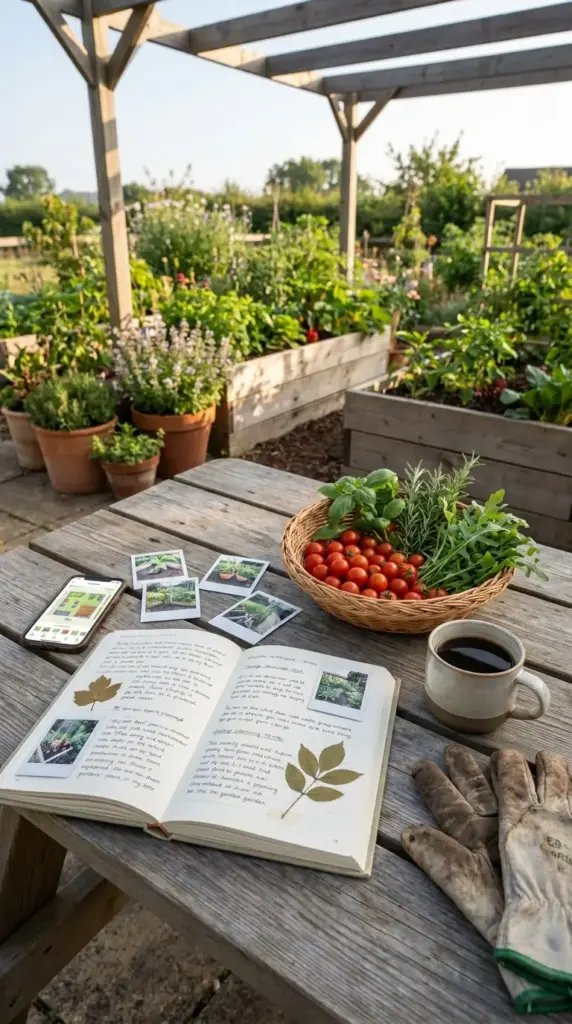
A dedicated garden journal is simultaneously your creative outlet, your planning tool, and your compliance documentation.
And it doesn’t have to be complicated. At all.
My simple garden journal system that actually works:
- Weekly photos of your garden from consistent angles — documents both beauty and compliance
- Planting dates and varieties for everything you grow
- HOA interaction notes — every conversation, letter, and approval documented carefully
- Harvest weights and yields — genuinely motivating to track over time
- What worked, what didn’t — honest seasonal reflections that make next year dramatically better
A beautiful hardcover garden journal also doubles as a coffee table book worthy conversation piece. Just saying. 😄
Seasonal Planting Guides Tailored to Major US Cities
Timing is everything in vegetable gardening — and generic planting guides often miss the mark for specific urban climates.
Here’s a simplified city-specific seasonal framework:
New York & Philadelphia
- Spring planting: April through May
- Fall planting: August through September
- Focus on cold-hardy crops for extended shoulder seasons
Chicago & Detroit
- Spring planting: Mid-May through June after last frost
- Maximize short growing seasons with fast-maturing varieties
- Cold frames extend your season by 6 to 8 weeks on both ends
Dallas & Atlanta
- Spring planting: February through March
- Fall garden: September through October — genuinely the best growing season
- Summer focus on heat-tolerant crops like okra, sweet potatoes, and southern peas
Seattle & Washington DC
- Nearly year-round growing possible with minimal protection
- Focus on brassicas, root vegetables, and leafy greens through winter months
- Take full advantage of mild shoulder seasons most cities don’t have
How to Scale Your Mini Farm Gradually
This is the strategic advice I wish someone had given me at the very beginning.
Start smaller than you think you need to. Then expand deliberately and quietly.
A gradual scaling strategy that keeps HOA complaints at bay:
- Begin with one or two raised beds or a container garden — establish your aesthetic credibility first
- Add new elements one at a time across multiple seasons rather than all at once
- Let each addition become normalized and appreciated before introducing the next
- Always frame expansions as landscape improvements in any HOA conversations
- Document every positive neighbor comment — genuine social proof matters enormously
The goal is making your mini farm feel like a natural evolution of your landscape rather than a sudden dramatic change. 🌿
Celebrating Your Harvests and Sharing Your Journey Online
This final piece is honestly about so much more than social media strategy.
It’s about building a community around something you genuinely love.
Sharing your urban homesteading journey online does something remarkable — it inspires other women in HOA communities who thought growing their own food was impossible.
Some practical ways to share and celebrate your harvests:
- Instagram and Pinterest — visual platforms perfectly suited for beautiful garden and food content
- Neighborhood Facebook groups — sharing harvests builds genuine local goodwill and HOA support simultaneously
- Recipe content featuring your homegrown ingredients — farm to table storytelling resonates deeply
- Before and after garden photos — some of the most engaging content in the gardening space
- Seasonal harvest reels — short, beautiful video content that performs extraordinarily well right now
Use hashtags like #urbanfarming, #HOAgarden, #hiddenfarm, #foodscaping, and #growyourown to connect with a genuinely passionate community of like-minded women.
Because here’s what I’ve learned after years of hidden mini farming in HOA communities — your journey matters.
Every container herb garden, every stealth raised bed, every espalier fruit tree represents a quiet act of self-sufficiency and creativity that deserves to be celebrated and shared. 🌸
Conclusion
Growing your own food in an HOA neighborhood isn’t just possible — it’s an art form. And honestly? The constraints make you more creative.
From vertical gardens that double as privacy screens to fruit trees that look like luxury landscaping, the 15 strategies in this guide prove that you don’t have to sacrifice beauty for function.
Start small. Pick one idea that excites you — maybe a container herb garden on your patio or a raised bed styled like a garden feature — and build from there. Your mini farm doesn’t have to happen overnight. It just has to start.
The most important thing? You’re not just growing food. You’re growing confidence, self-sufficiency, and a deeper connection to the home you’ve worked so hard to create. And no HOA rulebook can take that away from you. 🌿
Ready to start your hidden mini farm? Save this guide, share it with a neighbor who gets it, and drop your biggest HOA gardening challenge in the comments below!

GIPHY App Key not set. Please check settings