

 The Home Growns
What to Plant in a Raised Garden Bed for Maximum Harvest
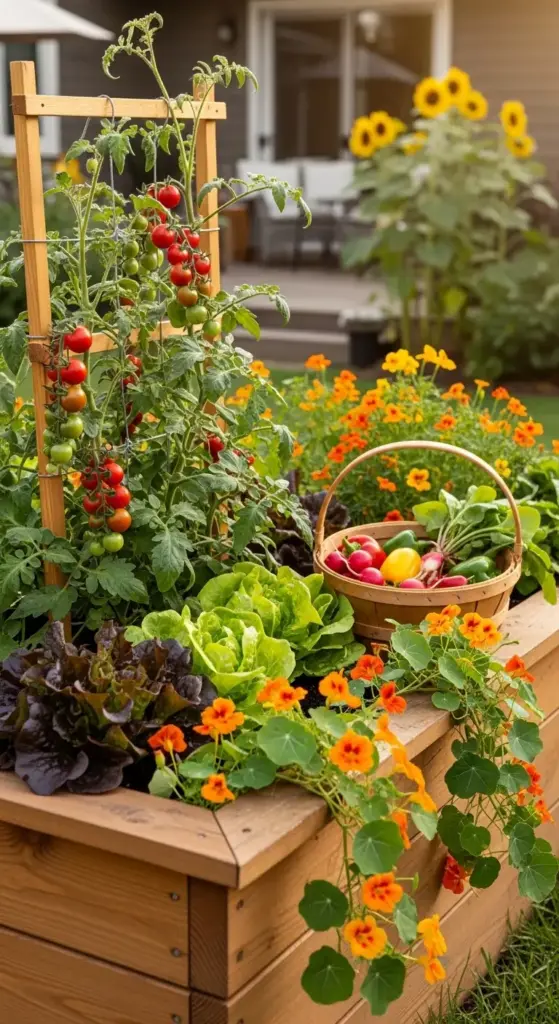
The first time I sat down to plan what to grow in my raised bed, I basically just bought every seed packet that looked interesting at the hardware store.
Cherry tomatoes, watermelon, giant pumpkins, Brussels sprouts, three kinds of basil. In a 4×8 foot bed.
It was chaos. Beautiful, ambitious, completely misguided chaos.
By July, my watermelon vine had taken over everything, my Brussels sprouts were shading out my peppers, and I was standing in my backyard genuinely confused about how things had gone so wrong so fast.
Planning what to plant — and how to plant it — matters just as much as the bed itself. Let’s do this the smart way.
The Best Vegetables for Beginners (Start Here)
If you’re new to raised bed gardening, resist the urge to go wild right away.
Start with plants that are forgiving, productive, and actually fun to grow. Here are the ones I recommend to every beginner without hesitation.
Tomatoes are the classic starter crop for a reason. They’re prolific, satisfying, and nothing from a grocery store comes close to a homegrown tomato. For raised beds, go with determinate varieties like Roma or Bush Early Girl — they stay compact and don’t take over your entire bed the way indeterminate varieties can. Expect to harvest roughly 10 to 15 pounds per plant in a good season.
Lettuce is probably the most beginner-friendly vegetable you can grow. It germinates fast — sometimes within 3 to 5 days — grows quickly, and can be harvested continuously by cutting outer leaves and letting the plant keep producing. It’s also one of the few vegetables that actually prefers a little shade, making it perfect for tucking into corners of your bed.
Zucchini is almost aggressively easy to grow. One or two plants will produce more zucchini than most families can eat — seriously, you’ll be leaving bags of it on your neighbors’ porches by August. Just don’t plant more than two unless you really love zucchini.
Peppers — both sweet and hot varieties — are compact, beautiful plants that produce heavily in warm climates. They love heat, so gardeners in Dallas, Atlanta, and Los Angeles will have especially great results. Bell peppers and banana peppers are great starter varieties.
Herbs deserve a permanent spot in every raised bed. Basil, parsley, chives, and cilantro are all easy to grow, incredibly useful in the kitchen, and expensive to buy fresh at the grocery store. Growing your own herbs alone can save a surprising amount of money over a season.
Companion Planting — Nature’s Version of Teamwork
This is one of those topics that sounds complicated but is actually pretty intuitive once you get the basic idea.
Companion planting means strategically placing plants near each other so they benefit one another — either by deterring pests, attracting pollinators, improving soil, or simply making efficient use of space.
It’s basically setting up good neighbors in your garden.
The most famous companion planting combination is called The Three Sisters — corn, beans, and squash — a planting method used by Native American farmers for centuries. The corn grows tall and gives the beans something to climb. The beans fix nitrogen in the soil, feeding the corn and squash. The squash spreads along the ground, shading out weeds and retaining moisture. Three plants, all helping each other. It’s genuinely elegant.
For raised beds specifically, here are some companion pairings that actually work:
Tomatoes + Basil is the classic combo. Basil is believed to repel aphids and whiteflies, and many gardeners swear it improves tomato flavor too. Science is still a little fuzzy on the flavor part, but the pest deterrence is real enough that I always plant them together.
Peppers + Marigolds is another winner. French marigolds release a compound from their roots that repels nematodes — microscopic soil pests that can devastate pepper plants. Plant them around the border of your bed for a protective ring that also happens to look gorgeous.
Lettuce + Tall Tomatoes or Peppers works beautifully in warm climates. The taller plants provide afternoon shade that keeps lettuce from bolting (going to seed) in summer heat. You’re essentially using vertical space to protect a more delicate crop.
Carrots + Onions is a classic pairing — carrot flies hate the smell of onions, and onion flies hate the smell of carrots. They basically protect each other.
What not to plant together is just as important. Fennel is famously terrible as a companion — it inhibits the growth of almost everything around it. Keep it in its own container. Onions and beans don’t get along either — onions stunt bean growth significantly.
Seasonal Planting Guide by U.S. Climate
This is where a lot of generic gardening advice falls apart — because what works in Seattle in March is completely different from what works in Dallas in March.
Let me break it down by region.
Northeast (New York, Philadelphia, Washington D.C.)
- Last frost dates typically fall between April 15 and May 15 depending on exact location
- Start tomatoes, peppers, and eggplant indoors 6 to 8 weeks before last frost
- Direct sow lettuce, spinach, and peas outdoors as early as late March — they can handle light frost
- Summer crops go in after Mother’s Day as a general rule of thumb
- Fall is excellent for a second round of leafy greens and root vegetables starting in August
Midwest (Chicago, Minneapolis, Detroit)
- Last frost dates run late April to mid-May, with Minneapolis pushing closer to May 15
- Winters are harsh and springs are unpredictable — don’t rush it
- Start seeds indoors in late February or early March for summer crops
- The growing window is shorter, so fast-maturing varieties are your best friend — look for tomatoes labeled “65 days” or less
- Cold frames or row covers can extend your season by 3 to 4 weeks on both ends
South (Atlanta, Dallas)
- You essentially get two growing seasons — spring and fall — which is an incredible advantage
- Spring planting starts as early as February for cool-season crops
- Summer heat is brutal for many vegetables — July and August are often too hot for tomatoes to set fruit above 95°F
- Use summer to grow heat-lovers like okra, sweet potatoes, and southern peas
- Fall garden starts in August and September and can run all the way to December or beyond
- Southern gardeners who figure out the fall garden are the ones with the most productive beds overall
Pacific Northwest (Seattle, Portland)
- Mild, wet winters and cool summers create a unique growing environment
- Last frost in Seattle is typically around March 15 to April 1 — earlier than most people expect
- Cool summers mean tomatoes and peppers need the warmest, most sheltered spot you can find — south-facing walls are ideal
- Brassicas (broccoli, kale, cabbage) absolutely thrive here and can be grown almost year-round
- Slugs are a serious pest in the Pacific Northwest — copper tape around your raised bed frame is a surprisingly effective deterrent
How to Plan a Continuous Harvest All Season Long
This concept changed my entire approach to gardening and I wish I’d learned it sooner.


It’s called succession planting, and the basic idea is simple: instead of planting everything at once and getting a massive harvest for two weeks followed by nothing, you stagger your plantings every 2 to 3 weeks so something is always ready to pick.
Think of it like a conveyor belt of fresh produce instead of a single big delivery.
Here’s how it works in practice. Instead of planting an entire row of lettuce at once, plant one-third of your lettuce seeds on week one, another third on week three, and the final third on week five. By the time your first planting is finishing up, your second planting is hitting its peak. Your third planting is just getting started.
The same principle applies to radishes, beans, cilantro, and spinach — all fast-growing crops that benefit enormously from succession planting.
For longer-season crops like tomatoes and peppers, focus instead on planting multiple varieties with different maturity dates. An Early Girl tomato (50 days) alongside a Brandywine (80 days) means you’re harvesting tomatoes for a much longer window than if you’d planted just one variety.
Keep a simple garden journal — even just notes in your phone — tracking what you planted and when. It sounds tedious but it makes succession planting so much easier to manage, and by year two you’ll have a personalized planting calendar that’s dialed in to your specific space and climate.
Kid-Friendly Plants That Make Gardening a Family Thing
Okay, this section is close to my heart because some of my best gardening memories involve getting kids excited about growing things.
There is something genuinely magical about watching a child pull a carrot out of the ground for the first time.
The key to gardening with kids is choosing plants that are fast, dramatic, and edible. Kids lose interest quickly if nothing seems to be happening, so you want plants that show visible progress within days.
Radishes are the ultimate kid crop. They germinate in 3 to 5 days and are ready to harvest in just 25 days. That’s fast enough to hold a child’s attention through the whole process.
Cherry tomatoes are perfect for kids because they produce constantly and can be eaten straight off the vine like candy. Sun Gold and Sweet 100 varieties are especially sweet and prolific.
Sunflowers aren’t edible in the traditional sense, but kids love them. Plant them at the back of your raised bed as a backdrop — they grow fast, get impressively tall, and the seeds can be harvested and roasted at the end of the season. It’s a full-circle growing experience that kids find really satisfying.
Snap peas are another winner — sweet, crunchy, and kids can pick and eat them directly from the vine. Sugar Snap is the classic variety and it’s hard to beat.
Strawberries are almost unfair in how much kids love them. They spread on their own, produce fruit that children will actually eat enthusiastically, and come back year after year. Plant a few along the edges of your raised bed and they’ll reward you for seasons to come.
Gardening with kids also builds real skills — patience, responsibility, basic science, and an understanding of where food actually comes from. For busy moms juggling a lot, a raised bed garden can become a genuinely meaningful family activity that doesn’t require a lot of extra time or equipment.
Edible Flowers and Herbs That Double as Garden Design Elements
This is the part where your raised bed stops being just a vegetable garden and starts being a designed outdoor feature.
And honestly? It’s one of my favorite things to talk about.
Edible flowers are exactly what they sound like — flowers you can actually eat — and they are stunning in a raised bed. They attract pollinators, deter pests, and make your garden look like something out of a magazine.
Nasturtiums are probably the most versatile edible flower for raised beds. They’re easy to grow from seed, bloom in vibrant oranges and yellows, and both the flowers and leaves are edible with a peppery flavor that’s great in salads. They also repel aphids and attract predatory insects that eat garden pests. Basically a beautiful, edible pest control system.
Calendula (pot marigold) is another powerhouse — bright orange blooms that attract beneficial insects, repel whiteflies, and can be used in teas, salads, and even skincare. They bloom prolifically from early summer through fall.
Lavender along the border of your raised bed does triple duty: it’s beautiful, it smells incredible, and it’s a powerful pollinator magnet that will bring bees to your vegetable plants and dramatically improve your yields.
Borage produces stunning blue star-shaped flowers that are edible and taste faintly of cucumber. It self-seeds freely, attracts pollinators aggressively, and is said to improve the growth and flavor of tomatoes planted nearby.
For herbs that pull double duty as design elements, purple basil is visually striking and works beautifully as a border plant. Rosemary grows into a substantial, architectural shrub over time. Chives produce pretty purple flowers in spring that are fully edible and look lovely scattered over salads.
The goal is a raised bed that looks intentional and beautiful from across the yard — not just a utilitarian box of vegetables.
Mix edible flowers and herbs into the edges and corners of your bed, let them spill slightly over the sides, and you’ll have something that genuinely looks designed rather than just planted.
Up Next: Raised Garden Bed Design Ideas to Beautify Your Space
You’ve got the plants. Now let’s talk about making the whole setup look incredible.
Because a raised bed garden doesn’t have to just be functional — it can be one of the most beautiful features in your entire outdoor space.
Tap Next below and I’ll share the layout styles, design ideas, and styling tricks that turn a basic raised bed into a backyard showstopper — including some seriously gorgeous ideas for small spaces and urban patios. 🌸



GIPHY App Key not set. Please check settings