

 The Home Growns
Gardening on a Budget: Grow More, Spend Less
I want to tell you something that the gardening industry definitely doesn’t want you to hear.
You do not need to spend a lot of money to grow a beautiful, productive garden. Not even close.
Some of my best growing seasons happened when I was on the tightest budget — when I had to get creative, resourceful, and intentional about every single dollar I spent. And honestly? Those constraints made me a better gardener. They forced me to focus on what actually matters and strip away all the unnecessary stuff I’d been convinced I needed.
The gardening industry is a $48 billion dollar market in the United States. There are a lot of people trying to sell you things you don’t need. So let’s talk about how to build a thriving garden without falling for any of it. 💸
How to Start a Garden for Under $50
Yes, it’s genuinely possible. I’ve done it multiple times, and so have thousands of other gardeners.
Here’s the key: you have to prioritize ruthlessly and get creative with containers.
The biggest expense in most beginner gardens isn’t the plants — it’s the pots. And here’s the thing about pots: plants don’t care what they’re growing in. They care about soil quality, drainage, sunlight, and water. The container is just a vessel.
Once I internalized that, everything changed.
The Under-$50 Starter Garden: A Real Budget Breakdown
Here’s exactly how to put together a functional, productive beginner garden for under $50:
| Item | Where to Buy | Estimated Cost |
|---|---|---|
| Seeds (herbs + lettuce) | Dollar Tree or online | $5-$8 |
| Potting mix (1 cu ft bag) | Walmart or Home Depot | $8-$10 |
| Upcycled containers | Items you already own | $0 |
| Hand trowel | Dollar Tree | $1-$3 |
| Watering can or repurposed jug | Dollar Tree or at home | $1-$3 |
| Drainage material (pebbles) | Backyard or dollar store | $0-$2 |
| Basic fertilizer (slow-release granules) | Walmart | $8-$10 |
| Plant markers (popsicle sticks) | Dollar Tree | $1 |
| Total | $24-$37 |
That’s a real, functional garden for under $40. And if you already have some of these items at home — which most people do — you can get started for even less.
DIY Planters and Upcycled Containers
This is where budget gardening gets really fun. 🎉
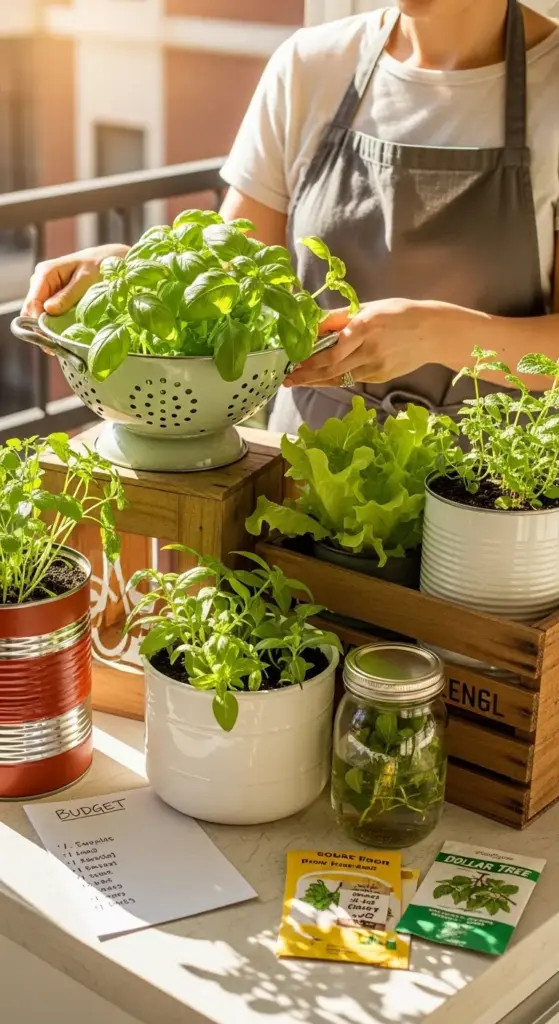
Almost any container that holds soil and has drainage can grow a plant. The creativity is entirely up to you — and some of the most beautiful small space gardens I’ve ever seen were built almost entirely from upcycled and repurposed containers.
Colanders and Strainers
Metal or plastic colanders are genuinely perfect planters — and most people have one sitting in a kitchen cabinet they never use.
They already have built-in drainage holes, they’re the perfect depth for herbs and lettuce, and a vintage metal colander filled with trailing herbs looks incredibly charming on a kitchen counter or balcony railing.
Line the inside with a layer of burlap or landscape fabric before adding soil to prevent the mix from falling through the larger holes. That’s it. Instant planter.
Wooden Crates and Wine Boxes
Wooden wine crates and produce crates are fantastic for small raised bed-style planters on a balcony or patio.
Line the inside with heavy-duty plastic sheeting or a garbage bag, poke a few drainage holes in the bottom, fill with potting mix, and you have a beautiful rustic planter that looks like it came from a boutique garden shop.
Where to find them for free: Wine shops and liquor stores often give away wooden wine crates — just ask. Grocery stores and farmers markets frequently have wooden produce crates they’re happy to part with.
Tin Cans and Mason Jars
Large tin cans — the kind that hold big quantities of tomatoes, coffee, or olive oil — make excellent small herb planters.
Use a hammer and nail to punch several drainage holes in the bottom, give the outside a coat of spray paint if you want a more polished look, and you have a planter that costs absolutely nothing.
Mason jars work beautifully for propagating cuttings in water and for growing small herbs like chives and mint on a windowsill. They photograph beautifully too — very Pinterest-worthy. 😄
Plastic Bottles and Jugs
2-liter plastic bottles and gallon milk jugs can be transformed into surprisingly effective planters with just a pair of scissors.
Cut the top third off a 2-liter bottle, flip the top section upside down inside the bottom section to create a self-watering planter, fill with soil, and plant your herbs. The inverted top acts as a water reservoir that slowly wicks moisture up to the roots.
This is a fantastic project to do with kids — and it teaches them about both gardening and recycling at the same time. 🌱
Fabric Grow Bags
If you want to buy something new, fabric grow bags are the most affordable purpose-built planter option available.
A 5-pack of 5-gallon fabric grow bags costs about $10-$15 on Amazon — that’s $2-$3 per planter. They’re breathable, promote healthy root growth, fold flat for storage in winter, and last for multiple seasons.
For the price, nothing beats them. They’re my top recommendation for budget-conscious beginners who want a reliable, functional container.
Where to Find Free or Cheap Seeds, Cuttings, and Starter Plants
This is the section that can save you the most money — because plants themselves are where budgets tend to balloon fastest.
Here’s the thing: plants want to reproduce. Nature is incredibly generous if you know where to look.
Seed Libraries
Seed libraries are one of the best-kept secrets in urban gardening — and they exist in almost every major US city.
A seed library works exactly like a book library: you borrow seeds for free, grow your plants, save seeds at the end of the season, and return them for other gardeners to use.
Where to find them:
New York: The Brooklyn Public Library and Queens Public Library both operate seed lending programs.
Chicago: The Chicago Public Library system has seed libraries at multiple branch locations.
Minneapolis: Hennepin County Library offers a robust seed library program with hundreds of vegetable, herb, and flower varieties.
Philadelphia: The Free Library of Philadelphia has a seed library program available to cardholders.
Washington DC: The DC Public Library seed library is one of the most well-stocked in the country.
If you have a library card, you have access to free seeds. It really is that simple.
Seed Swaps and Garden Exchanges
Seed swaps are community events where gardeners bring their saved seeds and exchange them with other gardeners — completely free.
They happen at farmers markets, community centers, botanical gardens, and garden clubs throughout the growing season. Search “seed swap [your city]” on Facebook Events or Eventbrite to find ones near you.
The bonus: You’ll meet other local gardeners who are often incredibly generous with cuttings, divisions, and starter plants too. The gardening community is genuinely one of the most giving communities I’ve ever been part of.
Propagating from Cuttings
Propagation is basically free plant cloning — and it’s easier than most people think.
Many popular herbs and plants can be propagated from a simple stem cutting placed in a glass of water. No special equipment, no cost.
Herbs that propagate easily in water:
- Basil — snip a 4-inch stem just below a leaf node, remove lower leaves, place in water, and roots appear within 7-10 days
- Mint — same process, roots even faster
- Rosemary — takes a bit longer (2-3 weeks) but works reliably
- Sage and thyme — both root well in water within 2-3 weeks
Ask friends, neighbors, or local gardening groups if they have cuttings to share. Most gardeners are thrilled to share — it’s practically a love language in the gardening world. 😄
Facebook Marketplace and Buy Nothing Groups
Facebook Marketplace and local Buy Nothing groups are absolute goldmines for free and cheap plants.


Search “plants free” or “garden plants” on Facebook Marketplace in your city and you’ll regularly find people giving away divided perennials, extra seedlings, starter plants, and even whole container gardens when they’re moving.
Buy Nothing groups — neighborhood-based free sharing communities on Facebook — are especially generous with plants. Gardeners with prolific growers like mint, lemon balm, and hostas are constantly giving away divisions because the plants multiply faster than they can use them.
I’ve furnished entire sections of my garden from Buy Nothing groups. Completely free.
End-of-Season Sales
This is one of the smartest budget gardening strategies that most beginners don’t know about.
Garden centers and home improvement stores like Home Depot and Lowe’s heavily discount their remaining plants at the end of the growing season — typically late August through October. We’re talking 50-75% off on perennials, herbs, shrubs, and flowering plants.
Many of these plants look a little rough — leggy, slightly wilted, maybe a few yellow leaves — but they’re almost always completely salvageable with fresh soil, proper watering, and a little TLC.
I’ve bought $15 lavender plants for $2 this way. Rosemary bushes for $1. Perennial herbs that come back every year for almost nothing.
The strategy: Buy perennial herbs and flowering plants at end-of-season sales, overwinter them indoors, and have a head start on next year’s garden for almost no money.
Community Gardening Programs in Major US Cities
Community gardens are one of the most underutilized resources for urban gardeners — especially beginners who don’t have outdoor space of their own.
A community garden plot gives you access to real ground space, shared tools, experienced gardeners, and a supportive community — often for a very small annual fee or completely free.
Washington DC
DC’s Department of Parks and Recreation operates over 20 community garden sites throughout the city, with plot rental fees as low as $20-$50 per year for residents.
The Rooting DC program specifically supports new and beginning gardeners with workshops, mentorship, and subsidized plot fees for low-income residents.
Search: “DC community gardens DPR” to find plots near you.
Philadelphia
Philadelphia Green, a program of the Pennsylvania Horticultural Society, manages one of the largest urban greening networks in the country with community gardens in every neighborhood.
The Neighborhood Gardens Trust also preserves and supports community garden spaces throughout the city. Plot fees vary by garden but are generally very affordable — many are free for neighborhood residents.
Minneapolis
Minneapolis has one of the strongest community gardening cultures of any US city — a reflection of the strong Midwestern community ethic.
The Minneapolis Park and Recreation Board manages over 30 community garden sites with plot fees ranging from $30-$75 per season depending on plot size.
The Gardening Matters organization also connects Minneapolis gardeners with resources, workshops, and community growing spaces.
Chicago
Chicago’s NeighborSpace program preserves and supports over 100 community garden sites throughout the city.
The Chicago Park District also operates community gardens in many of its parks, with plot fees typically around $25-$50 per season.
Chicago also has a robust network of rooftop gardens — particularly in neighborhoods like Wicker Park, Logan Square, and Lincoln Park — that sometimes offer volunteer opportunities in exchange for garden access.
New York City
GreenThumb, operated by the NYC Department of Parks and Recreation, is the largest urban community gardening program in the United States — supporting over 550 community gardens across all five boroughs.
Most GreenThumb gardens are free to join for neighborhood residents, though some have small membership fees. Gardens are member-run and offer a genuine sense of community alongside the growing space.
Search: “GreenThumb NYC” to find a community garden in your borough.
Seattle-Tacoma
Seattle’s P-Patch Community Gardening Program is one of the oldest and most established urban gardening programs in the country, with 90+ garden sites throughout the city.
Plot fees are income-based and sliding scale — ranging from about $35 to $75 per year — making it genuinely accessible for gardeners at every income level.
Waitlists can be long for popular P-Patch sites, so apply early and put your name on multiple lists.
Atlanta
The Atlanta Community Food Bank operates community garden programs throughout the metro area, with a focus on food access and gardening education.
Truly Living Well Center for Natural Urban Agriculture offers garden plots, workshops, and a strong community of urban growers in Atlanta — particularly focused on sustainable and organic growing practices.
Smart Shopping Tips to Stretch Every Dollar
Let’s wrap this section up with the practical shopping strategies that have saved me the most money over the years. 💰
Shop Dollar Tree First
Dollar Tree is genuinely underrated as a gardening supply source — and I say this without any hesitation.
Their garden section (especially in spring) regularly carries seed packets, small hand tools, spray bottles, plant markers, drainage trays, and basic planters — all for $1.25 each.
I buy my seed packets, spray bottles, and plant markers exclusively from Dollar Tree. The seeds are perfectly viable, the spray bottles work just as well as $10 ones, and the plant markers are identical to what garden centers sell for three times the price.
Buy Potting Mix in Bulk
Potting mix is significantly cheaper per cubic foot when bought in larger bags.
A 1-cubic-foot bag at Home Depot costs about $8-$10. A 2-cubic-foot bag costs about $12-$15 — that’s essentially the same price for twice the volume.
If you have multiple containers, always buy the largest bag available. It’s one of the easiest ways to reduce your per-container soil cost.
Use Coupons and App Deals at Home Depot and Lowe’s
Both Home Depot and Lowe’s have apps that regularly offer 10-20% off garden center purchases — especially at the beginning and end of the growing season.
The Home Depot app frequently has spring gardening promotions with significant discounts on soil, fertilizer, and plants. Download both apps and check them before every garden center trip.
Buy Seeds Online in the Off-Season
Seed prices online are dramatically lower than what you’ll pay at a garden center in spring — and the selection is infinitely better.
Baker Creek Heirloom Seeds (rareseeds.com), Botanical Interests, and Burpee all offer excellent quality seeds at very reasonable prices. A packet of seeds that costs $4-$5 at a garden center often costs $2-$3 online.
Buy seeds in late fall or winter when you’re planning next year’s garden — you’ll have the best selection and the most time to plan before the growing season begins.
Join Local Gardening Facebook Groups
Local gardening groups on Facebook are an incredible resource for budget gardeners — and they’re active in every major US city.
Members regularly post free plant giveaways, seed shares, tool loans, and gardening advice specific to your local climate. Search “[your city] gardening group” on Facebook and join every active group you find.
The generosity in these communities is genuinely remarkable. I’ve received free tomato seedlings, herb divisions, bags of compost, and even a full set of garden tools from local gardening groups — all completely free.
You’ve got the budget strategies down — now let’s talk about making your garden work for your whole family. Hit Next below and we’re diving into gardening with kids, pets, and a packed schedule — how to involve your little ones, keep your fur babies safe, and maintain a thriving garden even when life gets really busy. 🐾🌱 This one is especially for the moms out there. 👇


GIPHY App Key not set. Please check settings