

 The Home Growns
Garden Care Tips to Keep Your Backyard Looking Flawless All Year
I used to think great gardens just happened.
Like, some people were just blessed with a green thumb and the rest of us were doomed to watch our plants slowly decline while pretending everything was fine. Spoiler: that is absolutely not how it works.
What I eventually figured out — after killing more plants than I care to admit — is that a beautiful garden isn’t about talent. It’s about consistency. Small, regular habits that stack up over time into something that looks effortless from the outside but is actually the result of a really solid routine.
Let me walk you through exactly what that routine looks like. 🌿
Building a Simple Seasonal Garden Care Routine
The biggest mistake I see gardeners make is treating garden care like one big annual project instead of a series of small seasonal tasks.
When you break it down by season, it becomes so much more manageable.
Spring: The Reset Season
Spring is when everything happens fast — and I mean fast.
The moment soil temperatures hit around 50°F, things start waking up. That’s your cue to get outside and get moving before the garden gets ahead of you.
Early spring tasks (March to April depending on your zone):
Start by doing a full garden cleanup — remove dead plant material left from winter, rake out matted leaves from beds, and cut back any ornamental grasses that weren’t trimmed in fall. This is also the best time to divide overcrowded perennials before they put too much energy into new growth.
Apply a fresh 2 to 3-inch layer of compost to all your garden beds before new growth gets too tall to work around. Work it in lightly with a garden fork. This single task does more for your garden than almost anything else you’ll do all year.
Check your irrigation system if you have one — flush drip lines, replace any damaged emitters, and make sure everything is working before the dry season hits.
Mid to late spring tasks (April to May):
This is transplanting season. Get your cool-season crops in the ground — lettuce, spinach, peas, kale — as soon as your last frost date passes. Start hardening off any seedlings you started indoors by setting them outside for a few hours each day for about a week before transplanting.
Apply pre-emergent weed control to garden beds before weed seeds germinate. A thick layer of mulch works as a natural pre-emergent — or you can use a corn gluten meal product for an organic option that suppresses weed seeds without chemicals.
Summer: The Maintenance Season
Summer is not the time for big projects. Summer is the time to maintain what you’ve built.
The three words that define summer garden care: water, deadhead, watch.
Water deeply and consistently — more on this in a minute. Deadhead spent blooms to keep plants producing new flowers all season. And watch for pest and disease problems early, when they’re easiest to address.
Mid-summer is also when you want to side-dress your vegetable garden with a nitrogen-rich fertilizer to support continued production. A light application of fish emulsion or a balanced granular fertilizer around the base of tomatoes, peppers, and squash in July makes a noticeable difference in late-season yields.
Don’t forget to harvest regularly. Vegetables left on the plant too long signal the plant to stop producing. The more you pick, the more you get — especially with beans, zucchini, and cucumbers.
Fall: The Investment Season
Here’s the gardening secret that separates good gardens from great ones.
Fall is actually the most important season for next year’s garden. What you do in fall determines how your garden performs the following spring. Most people don’t realize this and completely check out after the first frost.
Early fall tasks (September to October):
Plant spring-blooming bulbs — tulips, daffodils, alliums, and hyacinths all go in the ground in fall for a spectacular spring show. In Zone 6 cities like New York and Philadelphia, plant bulbs in October when soil temperatures drop below 50°F. In Atlanta (Zone 7b to 8a), wait until November and choose pre-chilled bulbs since your winters aren’t cold enough to chill them naturally.
Divide and transplant perennials that have outgrown their space. Fall division gives plants time to establish roots before winter without the stress of summer heat. Hostas, daylilies, coneflowers, and ornamental grasses all divide beautifully in early fall.
Late fall tasks (October to November):
Cut back spent perennials — but not all of them. Leave ornamental grasses, coneflower seed heads, and black-eyed Susan stems standing through winter. They provide food for birds, habitat for beneficial insects, and honestly look beautiful covered in frost. Cut them back in late winter or early spring instead.
Apply a fresh layer of mulch to all beds after the ground starts to cool. This is your winter mulch — it insulates plant roots, prevents frost heaving, and keeps soil temperatures more stable through freeze-thaw cycles.
Winter: The Planning Season
Winter is not a gardening failure. Winter is a gift.
It’s the season to rest, reflect, and plan. Order seed catalogs. Review what worked and what didn’t in your garden this year. Sketch out any layout changes you want to make in spring. Research new plants you want to try.
In warmer climates like Atlanta, winter is actually a productive growing season for cool-weather crops. Kale, collards, spinach, and lettuce can be grown outdoors through most of the Atlanta winter with minimal protection.
In colder climates, use winter to maintain and sharpen your tools, clean and organize your shed, and start seeds indoors for early spring transplants. Tomatoes and peppers need 8 to 10 weeks of indoor growing time before your last frost date — which means starting seeds in late January or early February if you’re in Chicago or Minneapolis.
Watering Strategies That Actually Work
Okay, watering. This is where so many gardeners go wrong — and I was absolutely one of them.
For years I watered every single day, a little bit, from overhead with a sprinkler. My plants were constantly stressed, my soil was always either soggy on top and bone dry underneath, and I had chronic fungal problems on my tomatoes and roses.
Turns out I was doing almost everything wrong.
Here’s what actually works:
Water deeply and infrequently. Most established garden plants need about 1 inch of water per week — from rain or irrigation combined. Instead of watering a little every day, water deeply two or three times a week. Deep watering encourages roots to grow down into the soil where moisture is more stable, creating drought-resistant plants that need less babysitting.
Water at the base, not overhead. Overhead watering — sprinklers, watering cans aimed at leaves — promotes fungal diseases like powdery mildew, black spot on roses, and early blight on tomatoes. Water at soil level whenever possible.
Water in the morning. Morning watering gives foliage time to dry before evening, reducing disease pressure. Evening watering leaves plants wet overnight — which is basically an invitation for fungal problems.
Drip Irrigation: The Game Changer
I resisted setting up drip irrigation for years because it seemed complicated and expensive.
I was so wrong on both counts.
A basic drip irrigation system for a 4×8 raised bed costs around $30 to $50 in materials and takes about an hour to set up. You run a main supply line from your hose bib, then branch off with smaller drip lines that deliver water directly to the root zone of each plant. No overhead spray, no wasted water, no wet foliage.
The results are genuinely dramatic. Plants grow faster, disease pressure drops significantly, and you use 30 to 50% less water than overhead irrigation. In cities with water restrictions like Los Angeles or Atlanta during drought conditions, this matters a lot.
Soaker hoses are an even simpler alternative for garden beds. Lay them in a serpentine pattern through your bed, cover with mulch, and connect to your hose. Water seeps slowly along the entire length of the hose directly into the soil. They’re not quite as precise as drip emitters but they’re incredibly effective and cost around $15 to $25 for a 25-foot length.
Smart Watering Schedules by City
Here’s a quick regional guide because watering needs vary dramatically by location.


Seattle: Natural rainfall handles most of your watering needs from October through June. Supplement with irrigation only during the dry July through September window — typically 1 to 2 deep waterings per week during dry spells.
Atlanta: Hot, humid summers with periodic drought mean consistent irrigation from May through September. Aim for 1 to 1.5 inches per week during summer, adjusting for rainfall. Morning watering is especially important in Atlanta’s humidity to prevent fungal issues.
Minneapolis: Shorter growing season means less total irrigation needed, but summer heat waves can be intense. Monitor soil moisture closely in July and August — container plants may need daily watering during heat waves.
New York and Philadelphia: Moderate summer rainfall usually covers most needs, but July and August can be dry. A soaker hose system on a timer set to run twice a week covers most garden beds beautifully.
Mulching, Pruning, and Deadheading: The Polished Garden Trio
These three practices are what separate a garden that looks maintained from one that looks designed.
Mulching — we’ve talked about this throughout the guide, but it bears repeating. A fresh 2 to 3-inch layer of shredded hardwood mulch applied in spring and refreshed in fall does more for your garden’s appearance and health than almost anything else. It suppresses weeds, retains moisture, regulates soil temperature, and makes every bed look finished and intentional.
Keep mulch 2 inches away from plant stems and tree trunks — mulch piled against stems creates a moist environment that promotes rot and pest problems. This is called “volcano mulching” and it’s one of the most common — and damaging — mulching mistakes.
Pruning is about timing as much as technique. The general rule: prune spring-blooming shrubs right after they finish blooming. Lilacs, forsythia, and azaleas set their flower buds in summer for the following spring — prune them in fall and you’ll cut off next year’s blooms. Summer and fall-blooming shrubs like butterfly bush, panicle hydrangeas, and roses can be pruned in late winter or early spring before new growth begins.
For perennials, a technique called “the Chelsea chop” — cutting plants back by one-third to one-half in late May or early June — delays bloom time, creates bushier plants, and extends the flowering season. It sounds counterintuitive but it works beautifully on coneflowers, sedums, and asters.
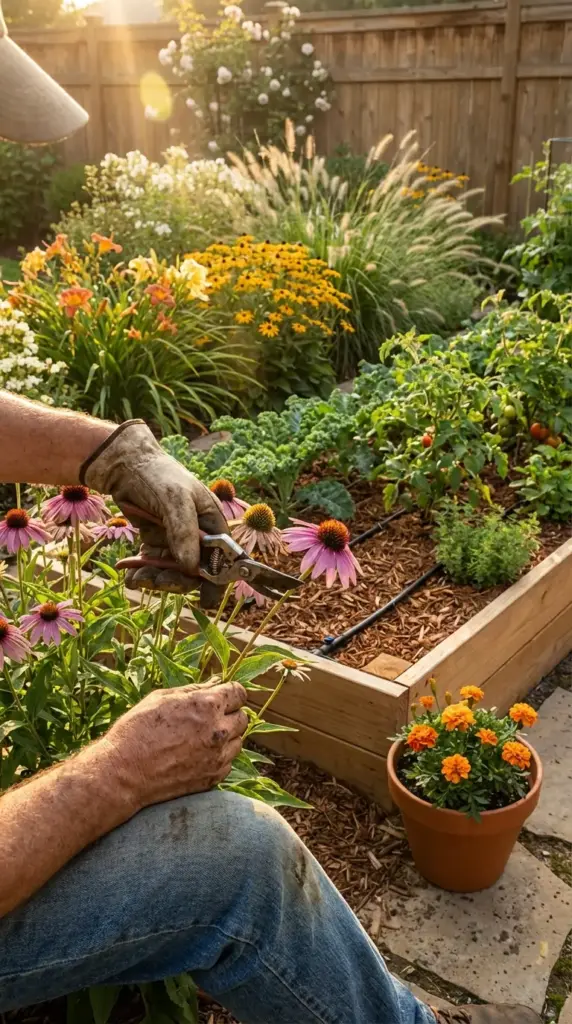
Deadheading — removing spent flowers — is the weekly habit that keeps your garden looking fresh and encourages continuous blooming. Most flowering plants will keep producing blooms as long as you prevent them from setting seed. Snip spent flowers just above the next set of leaves or buds. For prolific bloomers like coneflowers and black-eyed Susans, you can use garden shears to do a quick overall trim rather than deadheading flower by flower.
Exception: leave some seed heads on coneflowers and black-eyed Susans in fall — goldfinches absolutely love them and it’s one of the most delightful things you’ll ever watch in your garden.
Organic Pest Control Methods Safe for Kids, Pets, and Pollinators
This is a topic I feel really strongly about.
Your garden should be a safe space — for your kids, your pets, your neighborhood bees and butterflies, and the beneficial insects that are quietly doing so much good in your yard. That means being really thoughtful about what pest control products you use.
The good news? Organic pest control has gotten really effective. Here’s what actually works:
Neem oil is probably the most versatile organic pest control product available. It works against aphids, spider mites, whiteflies, fungal diseases like powdery mildew, and even some caterpillar pests. Mix 2 tablespoons of neem oil with 1 tablespoon of dish soap per gallon of water and spray on affected plants in the early morning or evening — never in direct sun or when pollinators are active. Repeat every 7 to 14 days as needed.
Insecticidal soap is safe, effective, and breaks down quickly in the environment. It works by disrupting the cell membranes of soft-bodied insects like aphids, mealybugs, and spider mites. It has no residual effect, which means it won’t harm beneficial insects that visit after it dries. Available pre-mixed or as a concentrate — the concentrate is much more economical.
Diatomaceous earth — food grade only — is a powder made from fossilized algae that damages the exoskeletons of crawling insects. Sprinkle it around the base of plants to deter slugs, beetles, and other crawling pests. Reapply after rain. It’s completely safe for mammals but avoid inhaling it — wear a dust mask when applying.
Companion planting as pest control — we covered this in the planting section, but it’s worth repeating here. Marigolds, nasturtiums, and basil planted throughout your garden deter a surprising range of pests naturally. This is prevention rather than treatment, and prevention is always better.
Encouraging beneficial insects is the long game of organic pest control. Ladybugs, lacewings, parasitic wasps, and ground beetles are voracious predators of garden pests. You attract them by planting dill, fennel, yarrow, and native flowers that provide nectar and habitat. A garden with a healthy beneficial insect population basically manages its own pest problems — it just takes a season or two to establish.
How to Winterize Your Garden in Colder Cities
This section is specifically for my readers in Detroit, Minneapolis, Washington DC, and other cities where winter is a serious force to be reckoned with.
Winterizing isn’t optional in these climates. Skip it and you’ll spend spring dealing with dead plants, frost-heaved perennials, and damaged structures that could have been easily protected.
Detroit (Zone 6a) and Washington DC (Zone 7a) have similar winterizing needs — cold enough to kill tender plants and freeze soil, but not as extreme as Minneapolis.
Minneapolis (Zone 4b to 5a) is in a different category entirely. Temperatures regularly drop to -20°F or below — which means plants rated for Zone 5 are genuinely at risk in a bad winter.
Here’s the winterizing checklist for cold-climate gardeners:
Cut back perennials — but as mentioned earlier, leave ornamental grasses, coneflowers, and other seed-head-bearing plants standing for wildlife. Cut back everything else to about 3 to 4 inches above the ground after a hard frost kills the foliage.
Mulch heavily after the ground freezes. The goal of winter mulch isn’t to keep the ground warm — it’s to keep the ground consistently cold. Freeze-thaw cycles are what damage plant roots and heave perennials out of the ground. A 4 to 6-inch layer of straw or shredded leaves over your beds after the ground freezes prevents those damaging temperature swings.
Protect marginally hardy plants with burlap wraps or frost cloth. In Minneapolis especially, roses, fig trees, and any plant at the edge of its hardiness zone benefit from extra protection. Wrap them loosely — you want insulation, not suffocation.
Drain and store irrigation systems before the first hard freeze. Water left in drip lines and soaker hoses will freeze and crack them. Blow out drip systems with compressed air or simply disconnect and drain all lines and store them in a garage or shed.
Bring in tender container plants — anything in a pot that isn’t rated for your zone needs to come inside before temperatures drop below freezing. Tropical plants, citrus, and tender perennials can overwinter in a garage, basement, or sunny window with minimal care.
Protect young trees and shrubs with tree wrap or burlap screens, especially in their first two winters before they’re fully established. Deer damage is also a serious issue in suburban Detroit and Minneapolis — burlap screens or deer repellent spray applied in late fall can save your shrubs from significant damage.
Quick Weekly Garden Maintenance Habits
Here’s the thing about garden maintenance that took me a long time to accept.
Fifteen minutes a week is worth more than four hours once a month.
Consistent small efforts prevent the kind of overwhelming backlog that makes you want to just close the blinds and pretend the garden isn’t out there. We’ve all been there.
Here’s a simple weekly garden walk routine that takes 15 to 20 minutes and keeps everything under control:
Monday or Tuesday — the assessment walk. Walk your garden slowly with a cup of coffee. Look for pest damage, disease symptoms, plants that need water, and anything that’s flopped over or needs staking. Make a mental or written note of what needs attention this week. This walk takes 10 minutes and prevents small problems from becoming big ones.
Mid-week — the quick tidy. Spend 15 minutes deadheading spent blooms, pulling any weeds that have appeared, and giving any thirsty containers a drink. Weeds pulled when they’re tiny take seconds. Weeds left for a month take a shovel and a bad mood.
Weekend — the deeper maintenance session. This is when you tackle anything from your assessment walk — staking a flopped peony, treating an aphid problem, trimming an overgrown edge. Keep this to 30 to 45 minutes maximum. If your weekly habits are consistent, you should never need more than that.
The one habit that makes the biggest difference? Never leave the garden without pulling at least five weeds. Just five. Every single time you’re outside. It sounds almost too simple — but over a full growing season, that habit alone keeps weed pressure at a completely manageable level.
The Garden Care Mindset
Here’s what I want you to take away from all of this.
A beautiful garden is not the result of one big effort. It’s the result of small, consistent habits practiced week after week, season after season.
Build your seasonal routine. Water deeply and smartly. Mulch generously. Deadhead regularly. Deal with pests early and organically. Winterize properly if you’re in a cold climate. And show up for your garden — even for just 15 minutes — every single week.
Do those things consistently and your garden will reward you in ways that genuinely surprise you.
🌿 Almost there — and this next section is one of my absolute favorites. We’re talking about the 3 easy backyard layout hacks that make a huge difference — even if you’re a total beginner. These are the shortcuts I wish someone had handed me on day one, and they work every single time. Hit that Next button below — you’re going to want to bookmark this one! ✨🌸


GIPHY App Key not set. Please check settings